Advertising a Franchise: A Playbook for High-Income Buyers
When we talk about advertising a franchise, we're really talking about the entire system you use to find, vet, and ultimately sign new owner-operators. For too long, the default strategy has been a wide-net approach on public portals. But the game has changed. Today, the smartest franchisors are building their own proprietary marketing systems designed to attract high-income, high-intent prospects with messaging that speaks directly to their goals—like wealth diversification and building a family legacy.
It's a shift from chasing volume to securing value, and it's about getting verified leads, not just a mountain of clicks.
Rethinking How You Advertise a Franchise

Let's be blunt: the old model of advertising a franchise is broken. For years, the standard playbook was to list your opportunity on crowded franchise portals and wait. The result? Your development team spends countless hours sifting through hundreds of unqualified inquiries just to find a single person who might be a fit.
This reactive approach is a massive drain on resources. It burns out your team, creates unpredictable growth, and wastes a huge chunk of your marketing budget. It's a numbers game you're set up to lose.
This playbook is all about flipping that script. It's built for established franchisors who are tired of the portal grind and ready to connect directly with the candidates they actually want. We're talking about high-income executives, directors, and experienced investors earning $150K-$500K+ who are seriously looking for their next move. The goal isn't to get more leads; it's to book more appointments with people who are actually qualified.
Traditional vs. Modern Franchise Advertising
The difference between the old way and the new way is night and day. One is a passive, volume-based numbers game, while the other is an active, value-driven strategy.
| Metric | Traditional Portal Advertising | Modern High-Intent Advertising | | :--- | :--- | :--- | | Audience | Broad, undefined, low-intent | Niche, affluent, high-intent | | Messaging | "Be your own boss," lifestyle-focused | Wealth diversification, legacy, asset class | | Lead Quality | Very low, high volume of tire-kickers | High, pre-vetted for financial capacity | | Team Effort | Reactive; sifting and chasing | Proactive; nurturing qualified prospects | | Cost | High cost-per-qualified-lead | Lower cost-per-qualified-lead | | ROI | Unpredictable and often low | Predictable and high |
Ultimately, the modern approach respects your team's time and focuses your budget where it will have the greatest impact—on conversations that lead to deals.
From Volume to Value
The real pivot here is understanding your ideal candidate's mindset. Traditional franchise ads often cast a wide net with a generic "escape the 9-to-5" message. But a senior manager or VP isn't just looking for a new job; they're making a calculated investment decision.
Their motivations are completely different. They are thinking about:
- Wealth Diversification: Shifting capital out of volatile stocks and into a tangible asset that produces cash flow.
- Legacy Building: Creating a business they can one day pass down to their kids or sell as a major financial exit.
- Applying Executive Skills: Putting their years of management and operational experience to work within a proven framework.
The goal is to stop competing for attention on public forums and start building a private, curated pipeline. By focusing on a narrow, affluent audience, you can transform your advertising from a cost center into a predictable revenue driver.
A System for Predictable Growth
What we're laying out here is a system that verifies a candidate's income and investment intent before a meeting ever lands on your calendar. Imagine your franchise development team spending their days only speaking with prospects who have already confirmed they have the financial means and are serious about moving forward.
The way you pull this off is by integrating precision targeting with an automated qualification funnel. We'll show you exactly how to pinpoint these ideal candidates on platforms like LinkedIn, craft ads that speak their financial language, and build a process that automatically weeds out the "tire-kickers" who drain your team's energy.
The result is a finely tuned machine that dramatically cuts down on wasted time and sends your lead-to-close rate through the roof.
Pinpoint Your Ideal High-Income Franchisee
If your franchise advertising isn't hitting the mark, the problem usually starts here: you don't have a sharp enough picture of who you're actually talking to. When you're trying to attract high-net-worth individuals, a generic target like "male, 45-60" is the equivalent of shouting into the wind.
Targeting a $200K/year executive requires a completely different mindset. You need to get past the surface-level demographics and build a rich profile based on real data. The goal is to understand their world so intimately that your advertising feels less like a sales pitch and more like a private conversation about their next big career move.
Go Deeper Than Demographics
Standard demographic data tells you almost nothing of value. The real magic happens when you layer in psychographic and behavioral insights. To successfully advertise a franchise to a seasoned professional, you have to know what drives them.
These aren't people swayed by "be your own boss" slogans. They're motivated by sophisticated financial goals and a deep-seated desire to apply their expertise in a new arena where they have more skin in the game.
- Firmographics: Look at the types of companies they work for. Are they in volatile but fast-growing tech sectors, or are they in stable industries like finance and healthcare? This context matters.
- Seniority and Titles: Get specific. VPs, Directors, and Senior Managers are often the sweet spot—they possess both the financial capacity and the operational savvy to succeed.
- Psychographics: This is where you find the gold. What keeps them up at night? Is it watching their 401(k) get battered by market volatility? A nagging feeling they haven't built a real legacy? Or the quiet realization they've hit a ceiling in the corporate world?
When you have these details, you can craft messages that hit on their specific career pressures and financial ambitions. You start speaking their language, and in doing so, you naturally filter out all the "tire-kickers" who waste your team's valuable time.
Use Data to Build Your Persona
This isn't guesswork. Platforms like LinkedIn Sales Navigator are phenomenal tools for this kind of reconnaissance. They let you build and analyze audiences with surgical precision based on professional criteria.
You can reverse-engineer your success by looking at your top-performing franchisees. For instance, after digging in, you might find a clear pattern: your best owners are often VPs of Operations from mid-sized manufacturing firms with an average tenure of 7-10 years. That's not a vague persona; it's a data-backed blueprint for your next advertising campaign.
Your ideal franchisee persona should be so well-defined it feels like you're describing a real person. Give them a name, a title, a salary, and a list of professional fears and personal ambitions. This makes it infinitely easier for your marketing team to create ads that feel personal and relevant.
Understand Their True Motivations
A six-figure executive doesn't just stumble onto a franchise portal. Their search is intentional and driven by powerful motivators. Your advertising must speak directly to these core drivers if you want to get their attention.
Key Motivations of High-Income Prospects:
- Wealth Diversification: They're smart enough to know the risks of having all their wealth tied up in stocks or a single W-2 salary. A franchise represents a tangible, cash-flowing asset to balance their portfolio.
- Direct Control Over Capital: These are leaders who are used to making decisions that produce results. They want to invest in a business where their strategic thinking and hard work directly influence the bottom line, rather than just hoping the market goes up.
- Building a Legacy: Many are looking past their next promotion and thinking about what they'll leave behind. They want to build a family asset, create generational wealth, or engineer a significant financial exit on their own terms.
Your ad copy and content need to reflect this sophisticated mindset. Stop talking about vague lifestyle benefits and start framing the opportunity in terms of portfolio growth, asset control, and equity building. This is the kind of nuanced approach that cuts through the noise and is a cornerstone of advanced franchise development. To see how a structured growth partner can help, explore our guide to high-growth franchise development services.
Putting Your Persona Into Action
Once you've built this detailed profile, it becomes the north star for your entire advertising strategy. Every ad, every blog post, and every email sequence should be engineered to attract this specific person.
This level of precision does more than just boost your lead quality. It dramatically lowers your Cost Per Qualified Lead (CPQL) because you've stopped wasting money on audiences who were never going to convert. You're effectively building a proprietary pipeline of candidates who are not just financially qualified but are also a perfect professional and cultural fit for your brand.
Weaving a High-Impact, Multichannel Ad Strategy
Trying to advertise a franchise to high-income prospects is nothing like traditional lead generation. These aren't people browsing franchise portals in their spare time. We're talking about busy executives, seasoned investors, and successful professionals who consume information across a very specific, curated set of channels.
To get their attention, you have to be in their world. This means creating a web of deliberate, trust-building touchpoints across the platforms they already use for financial news, career development, and networking. It's not about shouting from every rooftop; it's about being the credible voice they hear in all the right places.
Your Core Advertising Playbook
Your channel mix needs to be as sophisticated as the audience you're trying to reach. Forget the low-cost, low-intent franchise portals that attract dreamers. We need to focus on platforms where we can target with precision based on income proxies, job seniority, and professional interests.
Here's how we build a campaign to capture the attention of a $200K/year executive:
-
LinkedIn Ads: This is ground zero. It's the most direct path to targeting by specific job titles like "VP of Sales" or "Senior Director of Engineering," as well as by industry and company size. The entire goal is to place your opportunity squarely in the feed of professionals who have the right experience and the financial means to invest.
-
High-Value Content: You have to give before you get. We develop in-depth resources—think whitepapers, webinars, or detailed guides—that speak to their mindset. A few titles that work well are "From C-Suite to Owner: A Playbook for Diversifying Your Assets" or "How to Leverage 20 Years of Executive Experience into a Scalable Business." We then promote this content using LinkedIn Ads to capture qualified leads.
-
Niche Financial Newsletters & Forums: High-net-worth individuals are active in specific online communities and subscribe to newsletters covering wealth management, alternative investments, and market analysis. Placing sponsored content or ads here frames your franchise as a serious investment vehicle, not just another job alternative.
-
Strategic PR: Nothing builds trust faster than third-party validation. Getting your brand featured in a respected business publication or having your CEO quoted in a trade journal gives you a level of credibility that ads alone can't buy. For this skeptical audience, seeing you mentioned in a source they trust is critical.
The real magic happens when these channels work together. A prospect might see your ad on LinkedIn, then a week later read an article featuring your CEO, and finally download your whitepaper. Each touchpoint builds on the last, reinforcing your authority and moving them closer to taking the next step.
Crafting a Message for the Affluent Investor
The messaging that works for a typical franchise candidate will fall completely flat here. "Be your own boss" and "escape the 9-to-5" are slogans for a different audience with different motivations. For a high-income prospect, the conversation has to be about the numbers.
You have to stop selling a lifestyle and start presenting an asset class. These candidates evaluate a franchise the same way they'd evaluate a stock or a real estate deal: based on its potential for cash flow, equity growth, and portfolio diversification.
Your creative and copy should be built around themes that resonate with a sophisticated investor:
- Wealth Diversification: Position the franchise as a smart move to shift capital from volatile public markets into a tangible, cash-producing business they can influence.
- Legacy & Equity: Talk about building a durable asset for their family or engineering a significant capital exit down the road. This speaks directly to their long-term financial planning.
- Active Investment Control: Unlike with stocks or bonds, a franchise gives them the chance to apply their hard-won executive skills to directly impact their financial return. That level of control is a powerful motivator.
Example Ad Scenario:
Let's say we're targeting a Senior IT Director with 15+ years of experience. A generic franchise ad is a waste of money. A much smarter approach is an ad with a headline like, "Your Tech Leadership Skills Are Your Greatest Asset. Here's How to Invest Them." The ad copy would then connect the dots, explaining how their expertise in project management and team leadership is the perfect foundation for running a successful B2B service franchise.
The Data-Driven Future of Franchise Development
This kind of multichannel, data-backed approach isn't just a good idea anymore—it's quickly becoming the cost of entry for attracting top-tier franchisees. The market for franchise development services, which powers this exact type of advertising, is expected to jump from $8.38 billion in 2026 to $11.94 billion by 2030.
That 9.3% compound annual growth rate, detailed in the Franchise Development Service Market Report, is fueled by the very digital platforms and targeted methods we're talking about. The takeaway is clear: franchisors who master these tech-enabled advertising pipelines will win the race for the best candidates. The days of relying on gut feelings are over.
To learn more about how to put these principles into practice, take a look at our complete guide to building a high-performance franchise marketing strategy for 2026 and beyond.
From Click to Calendar: Automating Your Qualification and Appointment Funnel
Getting a flood of interest from your ads feels great, but it's a false victory if your development team is buried in unqualified inquiries. I've seen it happen time and again: a team spends 80% of its day just sorting through the noise. This isn't just inefficient; it's a huge waste of your best people's time.
The solution is to build an automated system that handles the heavy lifting—qualifying candidates and setting appointments for you.
This isn't about replacing human interaction. It's about making sure that when your team does get on a call, it's with a serious, financially-vetted prospect who is genuinely ready to talk. A smooth, automated funnel respects the candidate's time and positions your brand as professional and buttoned-up from the very first click.
Setting Up the First Filter: The Smart Lead Form
Let's start at the moment a prospect decides to raise their hand. It's time to ditch the basic "Name and Email" forms. Your lead form is your first line of defense, and it needs to be smart.
I'm a big believer in multi-step forms. They feel less intimidating to prospects because you start with easy questions and then ask for more detail. This simple psychological trick dramatically boosts completion rates. Your first few questions should do one thing really well: segment everyone instantly.
Here's what you absolutely need to ask:
- Liquid Capital: Don't be vague. Provide clear investment brackets like "$100K - $150K," "$150K - $250K," and "$250K+." This is your most critical data point, so make it a required field.
- Net Worth: This confirms their overall financial health and complements the liquid capital question.
- Ideal Timeline: A simple dropdown asking when they hope to open (e.g., "3-6 months," "6-12 months," or "12+ months") immediately tells you who the active buyers are versus the passive dreamers.
This isn't just data collection. It's the foundation of your entire automated process, telling you exactly who deserves your team's immediate focus.
Automating the Follow-Up to Get the Meeting
Once a prospect hits "submit," your system should take over. The goal here is twofold: continue to educate the candidate and drive them toward booking a call without any manual effort from your team. A short, strategic email sequence works wonders.
Here's a simple three-email flow that we've found to be incredibly effective:
- The Instant Confirmation: The second they submit the form, they should get an email. Thank them, and immediately give them something of value—a link to your franchise discovery guide or a personal video from your founder. This builds instant credibility.
- The Social Proof Nudge: About two days later, an automated follow-up can deliver a powerful franchisee testimonial or a case study. You can also add a gentle prompt, like, "As you prepare for a potential first call, you may find it helpful to review these franchisee success stories."
- The Direct Ask: The final email in this short burst gets straight to the point. Directly invite them to book a discovery call using a calendar link from a tool like Calendly or HubSpot. This eliminates all the frustrating back-and-forth scheduling.
If a candidate completes this sequence and still hasn't booked, no problem. The system can automatically move them into a longer-term monthly newsletter to keep your brand top-of-mind.
A well-built automation funnel does more than just schedule meetings. It educates prospects, builds trust, and ensures that by the time they speak with your team, they're already sold on the concept and confirmed to be financially capable.
The strategy of warming up and educating prospects before they even hit your funnel is key. This visual shows how different channels work together to make sure only high-intent individuals enter your qualification process in the first place.
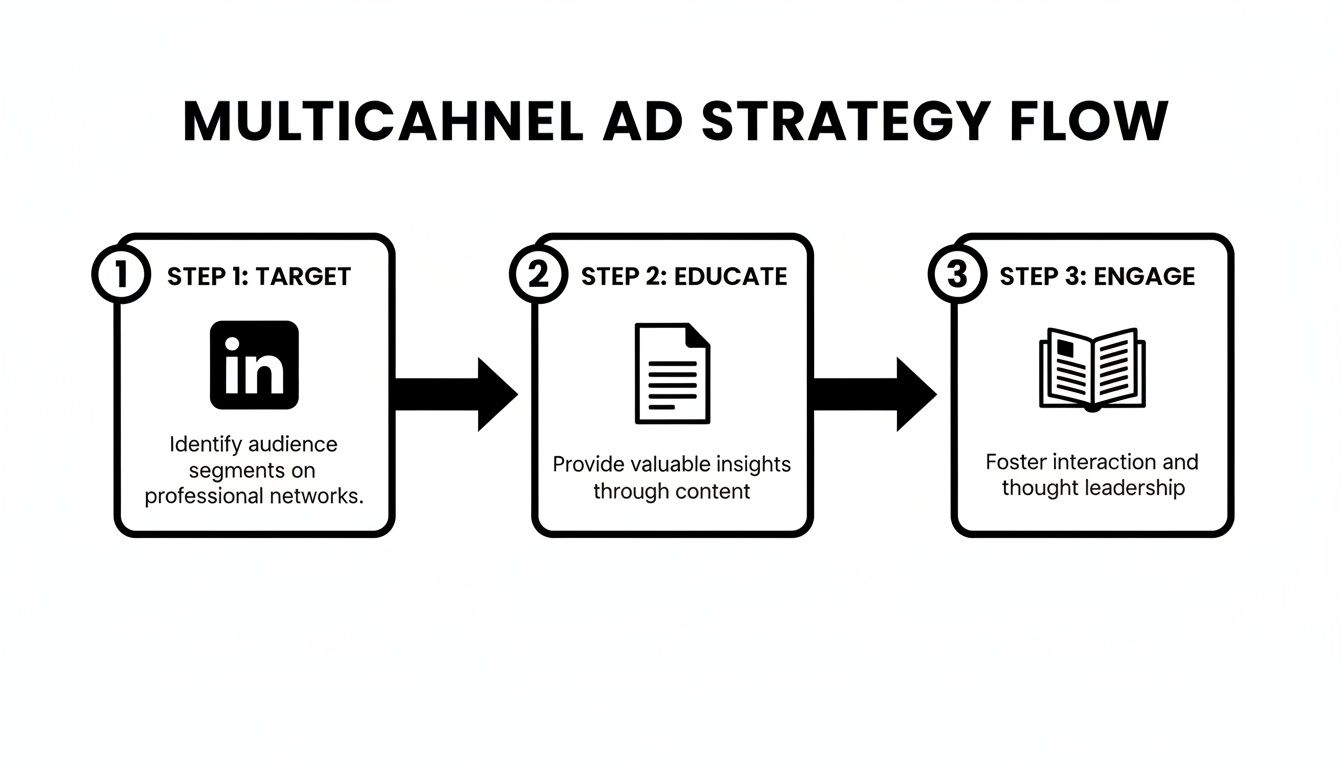
As you can see, the journey from a targeted LinkedIn ad to engaging with your content ensures that by the time they fill out your form, they are already highly informed and motivated.
This digital-first approach is exactly what's driving the industry forward. The global advertisement franchise market is projected to hit USD 1.32 billion by 2033, fueled by a 5.84% CAGR—growth powered almost entirely by the data-driven tools that make these funnels possible.
By automating the tedious front-end work, you're not just making your team more efficient; you're building a scalable growth engine for your brand. To get a better sense of the common pitfalls, check out our deep dive into why most franchise lead generation is broken. This automated system is designed to fix those exact problems.
Measure and Optimize Your Franchise Advertising Budget
In franchise development, you can't afford to fly blind. Throwing money at advertising channels without knowing your true return is the fastest way to burn your budget and come up empty-handed. When you're trying to attract affluent investors, vanity metrics like clicks and impressions are worse than useless—they're distracting.
Success isn't about getting the most leads; it's about getting the right leads at a cost that makes sense for your business.
Forget Vanity Metrics and Focus on What Counts
To get a real handle on your budget, you have to shift your focus to the numbers that actually track progress toward a sale. For franchise development aimed at high-income buyers, there are only a few metrics that truly matter.
These are the numbers that connect top-of-funnel ad spend to bottom-of-funnel results, giving you a crystal-clear picture of what's actually driving growth.
- Cost Per Lead (CPL): This is your starting point. It's a necessary metric, but it can be deceptive. A low CPL from a franchise portal might look good on paper, but if none of those leads are qualified, you're just paying for dead ends.
- Cost Per Qualified Lead (CPQL): This is where the real analysis begins. A qualified lead is someone who meets your specific criteria for liquid capital and net worth. Tracking CPQL tells you exactly how efficient your ad spend is at attracting people who can actually afford your franchise.
- Cost Per Appointment (CPA): This is the gold standard for top-of-funnel measurement. It's the cost to get a pre-vetted, high-intent prospect to book a meeting with your development team. Focusing on CPA forces your budget to drive real conversations, not just form-fills.
When you start measuring your advertising success by Cost Per Appointment, your entire strategy changes. You stop chasing cheap clicks and start investing in the channels and messaging that deliver qualified, motivated people who are ready to talk business. This single metric can transform your entire franchise advertising playbook.
Building Your KPI Dashboard
To keep these numbers front and center, you need a simple, centralized dashboard. This doesn't require expensive software; a well-organized spreadsheet gets the job done perfectly. The goal is an at-a-glance view of your pipeline's health.
For every advertising channel you're using (think LinkedIn, Niche Newsletters, PR campaigns), you need to be tracking:
- Total Spend: The total investment in that channel for the month or quarter.
- Leads Generated: The raw number of inquiries.
- Qualified Leads: How many leads passed your financial screening.
- Appointments Set: The number of qualified leads who actually booked a meeting.
- CPQL: Your total spend divided by the number of qualified leads.
- CPA: Your total spend divided by the number of appointments set.
With this dashboard, you can immediately spot your winners and losers. If LinkedIn is generating appointments at a $700 CPA while another source is costing you $2,500, you know exactly where to shift your budget next month to maximize your return.
A Framework for Budgeting and Optimization
Once your tracking is in place, you can move to a data-driven cycle of testing, measuring, and refining.
The market for quality franchisees is only getting hotter. The U.S. franchising sector is expected to see huge growth, with projections pointing to the launch of over 12,000 new franchised businesses and economic output hitting $921.4 billion. This growth, detailed in the 2026 economic outlook from the IFA, highlights the massive opportunity for franchisors who can build a predictable lead pipeline.
First, set a realistic budget by working backward from your goals. Don't just pick a number. If your target is to sign 10 new franchisees this year and your historical lead-to-close rate is 5%, you know you need 200 qualified appointments. If you aim for a target CPA of $800, your annual advertising budget should be $160,000.
Next, constantly A/B test your creative. Never assume you know which message will land. Run different ad headlines, images, and value propositions against each other. For example, you could test a message about "wealth diversification" against one focused on "building a family legacy." Let the CPA data tell you which one resonates most with your ideal prospects.
Then, use your data to refine audience targeting. You'll start to see patterns emerge. Maybe you find that VPs of Operations convert at a much higher rate than VPs of Marketing. Use that insight to double down on your most profitable audience segments and pull back from the ones that aren't performing.
Finally, analyze the full-funnel impact. Remember that not all channels have a direct, immediate CPA. Things like PR and content marketing are crucial for building the trust and credibility that make your direct-response ads work. While their direct CPA might be high or hard to track, they assist the channels that do convert. Look at the overall health of your pipeline, not just one metric in a vacuum.
By running this measure-and-optimize loop, you stop gambling with your ad spend and start building a predictable growth engine. You'll know exactly what's working, why it's working, and how to scale it.
Common Questions We Hear About Franchise Advertising
When you're trying to attract high-net-worth individuals to your franchise, the usual advertising playbook goes right out the window. It's a completely different ballgame, and it naturally brings up some tough questions. I've been in the trenches running these kinds of high-stakes campaigns for years, and these are the most common questions I get—along with the straight answers you need.
How Much Should We Budget for Advertising to High-Income Buyers?
Forget everything you know about flat-rate portal listings. That model is broken. The only way to win with this audience is to think in terms of performance, specifically your Cost Per Qualified Appointment (CPA).
So, what should you expect? For a fully vetted, confirmed appointment with a high-income prospect, a realistic starting point is between $500 and $1,500. I know that can sound steep if you're used to paying for cheap clicks or low-quality leads. But you have to shift your thinking to the final ROI. Paying more for one truly qualified candidate who actually has the capital and experience to close a deal is infinitely smarter than having your team chase dozens of unqualified leads who were never going to be a fit anyway.
This means your budget needs to be agile. You should be able to pour gas on the channels delivering appointments below your target CPA and quickly cut the ones that aren't.
What's the Most Common Mistake in Franchise Advertising?
Hands down, the biggest mistake is using generic messaging. High-income prospects—think executives, directors, and seasoned entrepreneurs—could not care less about slogans like "be your own boss" or "escape the 9-to-5." That's a message for a completely different demographic.
These sophisticated candidates are making an investment decision, not looking for a job. They want to see a compelling business case centered on wealth diversification, portfolio growth, and a chance to apply their executive skills to a proven model.
Your ads, landing pages, and follow-up emails must speak this language. You have to frame your franchise opportunity as a tangible asset class that generates cash flow and builds equity. Anything less just sounds amateur, and they'll tune you out immediately.
Which Platform Gives the Best ROI for Finding Wealthy Franchisees?
If you want to get your opportunity in front of someone with a specific job title, seniority level, and professional background, nothing beats LinkedIn. It's the most direct way to reach a "VP of Operations" or a "Senior Director" with a verified career history, putting you in front of people who have both the financial means and the business acumen you're after.
But putting all your eggs in one basket is a huge mistake. The best results always come from a smart, multi-channel strategy.
- LinkedIn Ads for that pinpoint targeting.
- Strategic Content, like whitepapers or case studies, promoted on business news sites to establish your authority.
- Targeted Display Ads across financial forums and publications to create a surround-sound effect.
This approach builds credibility from multiple angles. A prospect might see your ad on LinkedIn one day, and a week later, they're reading an article that features your brand on a site they already trust. It's this layering of touchpoints that creates real momentum and drives high-quality inquiries in a way a single channel never could. This is how you turn franchise advertising into a predictable system for growth.
Ready to stop wasting time on unqualified leads and start having conversations with verified, high-income buyers? Franchise Fast Track delivers a consistent pipeline of vetted appointments directly to your calendar. Learn how we can build your proprietary growth engine.
Ready to see results like these for your franchise?
Stop wasting money on leads that never close. Start getting hundreds of replies from high-income professionals daily.
Apply For Exclusive Access