A High-Performance Franchise Marketing Strategy for 2026
If you're still casting the widest net possible with your franchise marketing, you're not just wasting money—you're actively sabotaging your growth. The old approach of chasing sheer lead volume is a fast track to a pipeline full of unqualified prospects and a burnt-out development team. It's time for a fundamental shift.
Why Your Old Franchise Marketing Strategy Is Failing

Let's be direct: the franchise market is more crowded and competitive than ever. Growth is happening, but it's not being shared equally. If your playbook still relies on flooding franchise portals and running vague "be your own boss" ads, you're falling behind.
I've spoken with countless development leaders who are sick of sifting through a mountain of low-intent leads from people who can't even meet the basic financial requirements. This volume-first model creates a false sense of progress. It buries your team in admin work instead of letting them do what they're paid to do: build relationships and close deals with serious investors.
The New Reality of Franchise Growth
The entire dynamic of the franchise world has changed. While the sector is projected to add 12,000 new businesses and hit an economic output of nearly $921.4 billion in 2026, the real story is in the details.
Recent data shows that the top-ranked brands captured an incredible 93.16% of all new unit growth.
This winner-take-all environment means that a generic franchise marketing strategy is no longer viable. The top brands aren't just out-spending you; they are out-thinking you by focusing on quality over quantity.
This isn't just about bigger budgets. The most successful franchisors are winning because they have a sophisticated marketing system built to attract a very specific buyer—a high-net-worth individual looking for a solid investment, not just a job. For a more detailed breakdown, you can read our guide on franchise growth strategies for sustainable scale.
Shifting From Volume to Value
The single most important pivot for any ambitious franchisor is moving away from a volume-based mindset to a value-driven one. The old way celebrated the number of leads in the funnel. The new way measures success by the number of qualified appointments and, ultimately, signed agreements.
This table highlights just how different the two approaches are.
Franchise Marketing Focus Shift From Volume to Value
| Metric | Outdated Volume-Based Strategy | Modern Value-Driven Strategy | | :--- | :--- | :--- | | Primary Goal | Generate the highest number of leads possible. | Attract a pipeline of verified, high-intent investors. | | Key Metric | Cost Per Lead (CPL) and total lead count. | Franchise Acquisition Cost (FAC) and Lead-to-Close Rate. | | Targeting | Broad demographic and geographic nets. | Hyper-targeted personas based on income, net worth, and professional background. | | Messaging | "Be your own boss," lifestyle-focused benefits. | Investment diversification, operational excellence, and portfolio growth. |
Making this change means completely rethinking your channels, your messaging, and how you qualify candidates. It's about building a predictable system for attracting the right people from the start, which is the cornerstone of any high-performance franchise marketing plan.
Before you pour a single dollar into marketing, you have to know exactly who you're talking to. A fuzzy idea of "successful business people" or "folks with money" is a surefire way to burn through your budget on a flood of unqualified leads. The entire foundation of a winning franchise marketing plan rests on a crystal-clear, detailed franchisee persona.
This isn't just about listing off demographics. When you're selling a high-investment franchise, you have to dig much deeper. We're talking about sophisticated candidates, often with household incomes in the $150k to $500k+ range, who have the liquid capital and business acumen to match.
It's All About the "Why": Getting into the Psychographics
Knowing their income is just the entry ticket. Understanding their mindset is what actually gets a deal signed. These high-earning professionals aren't just swapping one job for another; they're making a serious, calculated investment. Your persona has to capture their real motivations, their biggest fears, and what they hope to achieve.
Start by asking yourself some pointed questions:
- What's their professional story? Are they a VP of Sales who's sick of the corporate grind? A seasoned Director of Operations ready to build something of their own? Maybe they're a successful entrepreneur in a completely different industry looking to diversify.
- What are their real financial goals? Is this about building a family legacy? Generating semi-passive income for retirement? Or are they aiming to become a multi-unit titan?
- Where do they get their information? Do they pore over The Wall Street Journal, listen to their financial advisor, or trust the recommendations from their peer network?
- What keeps them up at night? Is it the fear of operational headaches? Worrying about the level of brand support? Anxiety over a crowded market?
Answering these questions transforms your target from a generic statistic into a real person. That's how you craft messaging that actually lands.
Think about the difference. Targeting a vague "business owner" results in bland, forgettable ads. But what if you're targeting a "48-year-old VP of Operations with a $2M net worth who wants to diversify her portfolio before she retires"? Suddenly, you can create hyper-specific, compelling content that speaks directly to her ambitions and anxieties.
Where to Find the Data to Build Your Persona
This isn't just a creative writing exercise. You can—and should—build this profile with real-world data. Your best source of truth is sitting right in your CRM: your existing franchisees. Take a hard look at your top performers. What were their careers before they joined you? What pushed them to make a change? What did their discovery process look like?
From there, some powerful tools can give you incredible insight.
- LinkedIn Sales Navigator is an absolute goldmine for this kind of work. You can filter by job title (like Director or VP), industry, company size, and location to get a clear picture of your target candidate's professional world. It helps you see their career paths and where they hang out online.
- Professional Directories and Associations are another fantastic resource. If you're targeting physical therapists for a health and wellness franchise, for example, their industry association websites and magazines tell you exactly what topics they care about.
This deep persona work informs every single part of your franchise marketing—from the channels you choose to the ad copy you write. It's the difference between shouting into an empty room and having a meaningful conversation with someone who is genuinely ready to invest. It's also a crucial piece of building a high-growth system that attracts serious players. You can read more on this in our guide to the right franchise development services for scaling your pipeline.
When you invest the time upfront to define your ideal franchisee, you create a North Star for your entire development effort. Every decision gets easier and more effective because you know precisely who you're trying to reach. This is what separates the brands struggling with lead quality from those seeing predictable, impressive growth.
Where the Real Action Happens: Going All-In on Local
Let's get one thing straight: the old playbook of blanketing the country with national brand ads to attract franchisees is officially dead. If you're still pouring the bulk of your budget into broad awareness campaigns, you're not just wasting money—you're fishing in an empty pond.
The game has completely changed, especially for high-investment franchises. Success isn't found on national TV spots; it's won on the ground, territory by territory. It's about creating an interconnected system where your best candidates see you, trust you, and engage with you across different platforms, all with a sharp local focus.
The Undeniable Power of Local Store Marketing
We've seen a massive pivot among the smartest, fastest-growing franchisors. They're redirecting their dollars away from national vanity metrics and into local store marketing (LSM), and the results are impossible to ignore.
Recent data shows that brands dedicating 60% or more of their marketing budgets to LSM are seeing same-store sales growth spike between 12-18% annually. Their local campaigns generate 3.5 times higher engagement and a 47% better lead conversion rate than their national counterparts.
For 2026 and beyond, the most effective budget model we've seen looks like this: 65-70% goes directly to local marketing and trade area development, 20-25% supports regional efforts, and a slim 10-15% is left for national brand building.
This isn't about tossing your franchisees a few hundred bucks for a local newspaper ad. It's a corporate-driven strategy, executed locally. You provide the sophisticated tools and playbook; they use it to dominate their market.
This hyper-local approach is designed to attract a very specific type of person—the high-net-worth, experienced operator you actually want.
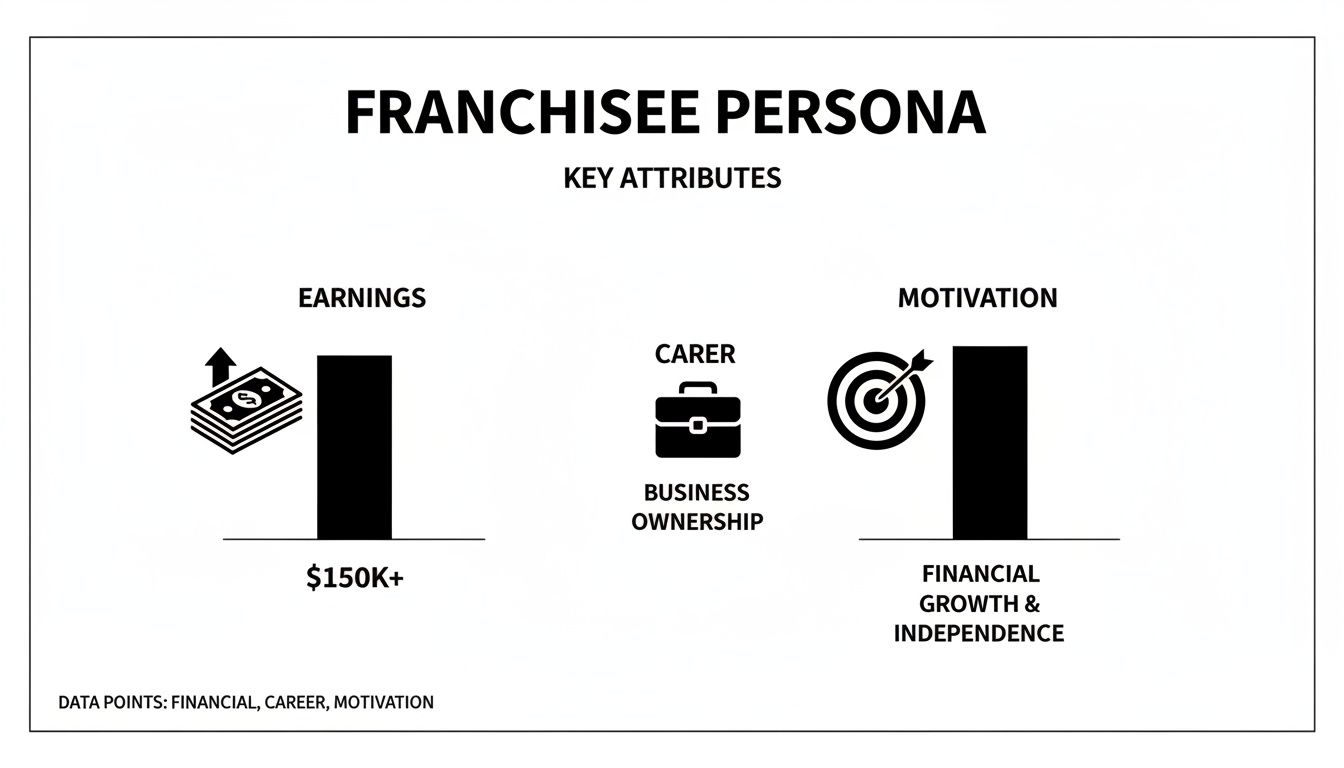
As you can see, your local message needs to connect with someone who is already successful and is looking for their next big move toward greater financial independence, not just a job.
Choosing Your Channels to Reach the Investor Class
Now that your budget is aligned with a local-first strategy, you have to be surgical about where you spend it. You're not trying to be everywhere. You're trying to be in the few places where serious investors spend their time and do their research.
This means a carefully curated mix of digital channels that prioritize precision over reach.
- Go Deep on LinkedIn: This is your prime territory. Stop targeting generic job titles. Use LinkedIn Sales Navigator to build laser-focused lists of Directors, VPs, and C-suite executives with the right industry background and years of experience. Your ads shouldn't shout "buy a franchise!" They should offer valuable content that speaks to them as an investor.
- Get Smart with Search (SEM): Forget burning cash on broad terms like "franchise for sale." Your ideal candidate is much more specific. Focus your bids on long-tail keywords that signal real intent, like "multi-unit franchise investment" or "executive franchise model." Crucially, geo-target these campaigns only in the territories you need to fill.
- Create Content That Demands Respect: High-net-worth individuals are allergic to fluff. They're persuaded by data, deep analysis, and proven success stories. Your content needs to be a credible resource they can use in their due diligence process.
Content That Converts an Executive
What does that kind of content look like in practice? It's substantive, insightful, and directly addresses the tough questions a sophisticated buyer will have.
- In-Depth White Papers: Produce and gate a serious piece of analysis like "A CEO's Guide to Portfolio Diversification Through Franchising" or "Analyzing Unit Economics in High-Growth Sectors." This isn't a brochure; it's a strategic brief that captures high-quality lead data.
- Real-World Case Studies: Go beyond a simple testimonial. Profile a top franchisee by detailing their background (e.g., "former tech VP"), their financial ramp-up, and their path to multi-unit ownership. Use real numbers wherever possible to establish rock-solid credibility.
- Exclusive Leadership Webinars: Host invite-only webinars with your CEO or Head of Development. The topic should be a high-level discussion on market trends or operational strategy, not a sales pitch. This positions you as an industry leader and gives prospects invaluable access to your top brass.
When you pair this dominant local focus with a precise channel mix and high-caliber content, you're not just generating leads anymore. You're building a system that consistently attracts the right partners—experienced, well-funded operators who are ready to build an empire with you.
Crafting Messaging That Resonates with Investors
Let's get one thing straight: your ideal franchisee candidate isn't just looking for a new job. They're evaluating your franchise as a serious investment, and your messaging has to speak that language. Forget the generic slogans like "be your own boss" or "live your passion." For high-net-worth individuals, those phrases are a major turn-off.
These sophisticated candidates are thinking in terms of ROI, operational efficiency, and portfolio diversification. To even get on their radar, every piece of your marketing—from ad copy to landing pages—needs to show you understand what drives them. It's time to stop selling a lifestyle and start presenting a powerful business opportunity.
Shift from Lifestyle to Legacy
The heart of your messaging must pivot from personal freedom to financial strategy. High-income executives and experienced entrepreneurs are wired differently. Your copy has to connect with their deep-seated ambition to build wealth, create a lasting legacy, and add a resilient, cash-flowing asset to their portfolio.
Every ad and landing page should proactively answer the questions they're already asking themselves:
- How solid are the unit economics?
- What's the real path to multi-unit ownership?
- Just how sophisticated is the operational support system?
- Is this a business model built to last for the next decade?
Your messaging should function as a natural filter. The goal is to clearly communicate the strength of your business system and the exclusivity of the opportunity, attracting serious investors while politely showing the window shoppers the door.
When you take this approach, you're signaling that you run a serious business for serious people. It instantly builds credibility and frames the entire conversation around a strategic partnership for growth, not just the sale of a single franchise unit.
Examples of High-Impact Messaging
So, what does this investor-first mindset look like in practice? Let's translate the theory into actual ad copy and outreach that cuts through the noise. Notice how the focus shifts to tangible business outcomes and strategic value.
Landing Page Headlines That Work
- Weak: "Own a Successful Fitness Franchise"
- Strong: "An Executive Model for Portfolio Diversification: Explore Our Multi-Unit Health & Wellness Opportunity"
LinkedIn Ad Copy
- Weak: "Tired of the 9-to-5? Be Your Own Boss!"
- Strong: "For VPs and Directors Seeking to Build an Asset Portfolio: Our proven operational model is designed for executive leaders. Download our economic model brief to review the numbers."
Email Outreach to a Targeted List
- Weak: "Have you considered franchising?"
- Strong: "John, with your background in logistics at XYZ Corp, I believe our multi-unit development model could be a strong strategic fit for your next move. We're seeking an operator to secure the Austin market."
This kind of specificity is what works. It shows you've done your homework and you respect the candidate's time and intelligence, which immediately elevates the conversation.
Communicating Your Core Value Pillars
To make your message stick, build it around three core pillars that appeal directly to an investor's mindset. Every single ad, email, and conversation should be grounded in these points, backed by real data and evidence.
-
Unit Economics and Scalability: This is your knockout punch. Lead with your Item 19 data, average unit volumes (AUVs), and franchisee profitability. Don't just mention multi-unit ownership; show them the roadmap from a single location to a regional empire.
-
Operational Excellence and Support: Remember, investors are buying a system, not a job. Detail your corporate support infrastructure, from the supply chain and tech stack to the marketing systems that drive customers. Emphasize how your model is designed to reduce operational drag for owners.
-
Exclusivity and Market Opportunity: High-net-worth candidates are naturally drawn to scarcity. Highlight prime, available territories and the limited chance to partner with your brand in a key market. Frame it as what it is: an opportunity to secure a valuable, long-term asset before someone else does.
By building all your creative around these pillars, you align your brand with what truly motivates your ideal franchisee. This ensures your marketing dollars attract candidates who are ready, willing, and able to make a significant investment.
Turning a Lead Into a Qualified Appointment
Getting a high-net-worth prospect to raise their hand is a great start. But that's all it is—a start. The real measure of your franchise marketing strategy is what happens in the messy middle, between the initial inquiry and a booked meeting. This is precisely where most systems fall apart, leaving development teams to drown in a sea of leads that ultimately go nowhere.
Franchise development interest is at an all-time high. A recent Reshift Media report highlighted that search interest is peaking, and click-through rates show a clear surge in active candidates. For development leaders, this influx of attention is a double-edged sword. You need a rock-solid, data-driven process to sort through the noise, or you'll get completely overwhelmed. You can dig into the data yourself and see the full picture on 2026 lead generation trends.
This stage is all about one thing: moving a raw lead to a qualified, booked appointment on your calendar without wasting anyone's time.
The Right Tech for the Job
Let's be honest: if you're still tracking leads on a spreadsheet, you're setting yourself up for failure. When you're dealing with hundreds of inquiries, manual tracking just doesn't cut it. A modern qualification engine needs a few core technologies to automate the heavy lifting and bring clarity to your pipeline.
At the very least, your tech stack needs these two pieces working together:
- A Solid CRM (Customer Relationship Management): This is your central nervous system. Every lead, every email, every phone call—it all lives here. Your CRM gives you a single source of truth for your entire pipeline. For a franchise, it's critical that it can handle specific data points like liquid capital, net worth, and target territories.
- A Marketing Automation Platform: This tool is your nurturing powerhouse. It plugs into your CRM and sends automated, personalized email sequences to new leads. This keeps your brand top-of-mind while your team is busy with higher-value conversations.
These tools are designed to work together, automatically scoring and segmenting leads so your development directors spend their days talking to people who can actually close a deal.
How to Build a Smart Lead Scoring System
Lead scoring is the engine that makes your qualification process run. Think of it as an automated system that assigns points to leads based on who they are and what they do, instantly separating the hot prospects from the tire-kickers. It's what allows your team to prioritize with ruthless efficiency.
A good scoring model should weigh two types of data:
- Explicit Data (What they tell you): This is the information a prospect gives you on a form. For franchising, the big ones are liquid capital, net worth, their timeline to invest, and any relevant industry experience.
- Implicit Data (What they do): This is all about behavior. A prospect who downloads your Item 19, visits the investment page three times, or watches your entire webinar replay is screaming intent.
A lead with $500k in liquid capital who also downloads your unit economics white paper is exponentially more valuable than someone who just submits their email. Your scoring system needs to reflect that, bumping that high-intent lead straight to the top of the follow-up list.
This kind of automated triage is what keeps your best leads from going cold while your team sifts through a mountain of unqualified inquiries.
Bridging the Gap Between Marketing and Sales
One of the most common friction points in franchise development is the handoff from marketing to the sales team. Far too often, leads are tossed over the wall without any real vetting, which just leads to frustrated development directors and a lot of wasted time. It's a systemic problem, and we've written before about why traditional franchise lead generation is broken.
This is where a specialized growth partner can completely change the game for your franchise marketing strategy. Instead of trying to build and manage an internal team to handle qualification, nurturing, and appointment setting, you can plug into a system built specifically for this function.
A partner like Franchise Fast Track takes ownership of that entire middle funnel. We don't just hand you raw leads. We identify high-income executives, verify their investment goals and financial capacity, and only then do we book a confirmed meeting directly on your development team's calendar.
The impact is immediate. Your team goes from spending 80% of their time prospecting and qualifying to dedicating 100% of their focus on what they were hired to do: build relationships and close deals with pre-vetted, high-intent candidates. It transforms your funnel from a leaky bucket into a direct pipeline of qualified appointments.
Your Franchise Marketing Strategy Questions Answered
Building a high-performance franchise marketing machine isn't straightforward. Once you pivot from a "more is more" volume game to a precision-based approach, a whole new set of questions always seems to pop up.
These aren't just academic exercises; they're the real-world hurdles I see franchise leaders face every day. Getting them right is the key to building a predictable pipeline of high-net-worth candidates and finally hitting your growth targets. Let's dig into a few of the most common ones.
How Do I Effectively Measure the ROI of My Franchise Marketing Strategy?
If you're still obsessing over Cost Per Lead (CPL), it's time for a change. That metric is a holdover from an outdated era of chasing volume. For high-investment franchises, your dashboard needs to tell a story about pipeline quality and sales efficiency, not just lead quantity.
I tell my clients to focus on three core metrics instead:
- Cost Per Qualified Lead (CPQL): This tells you the real cost to find someone who actually meets your minimum financial and experience criteria.
- Cost Per Application: This measures your investment to get a fully vetted candidate to formally commit to your discovery process.
- Franchise Acquisition Cost (FAC): This is the bottom line. It's the total marketing and sales expense to sign a new franchisee, revealing the true cost of growth.
Think of it this way: a social media campaign might get you leads for $50 a pop. But if none of them have the capital to invest, your ROI is zero. A targeted partnership, on the other hand, might deliver a pre-vetted appointment for $1,500, but if that person signs a deal, the ROI is massive and your FAC is right where it needs to be.
You have to track lead-to-appointment and appointment-to-close rates for every single channel. It's the only way to know which sources are actually making you money and which are just making noise.
What Is the Biggest Mistake Franchisors Make with Their Marketing Budget?
The single most expensive mistake I see is dumping the majority of the budget into top-of-funnel, national brand awareness campaigns. Too many franchisors get lured in by the idea of broad name recognition, pouring money into portals and generic ads that bring in a flood of unqualified leads.
This approach just drains your budget and burns out your development team. The most effective strategies I've seen for 2026 and beyond completely flip that old model on its head.
Here's the winning formula:
- Dedicate 65-70% of your budget to hyper-targeted digital campaigns and Local Store Marketing aimed directly at your ideal franchisee persona.
- Set aside 20-25% for regional support and market-specific pushes.
- Spend no more than 10-15% on broad, national branding efforts.
Your goal isn't for everyone to know your name. It's for the right few—the ones who are actually ready and able to invest—to find you easily. A truly successful franchise marketing strategy is all about surgical precision, not spraying and praying.
How Can I Protect My Brand's Category Exclusivity While Growing?
It's a valid fear. When you have aggressive growth goals, the last thing you want is market saturation or brand cannibalization. But this is exactly the kind of problem a precise marketing strategy is built to solve. It's all about growing smarter.
First off, your digital marketing needs to be geographically surgical. When you run paid search or social media ads, focus your spend only within available, high-potential territories. This stops you from generating interest in sold-out markets, which prevents a lot of candidate frustration and brand confusion down the line.
Second, consider partnering with a growth partner that offers true exclusivity. This can be an incredibly powerful strategic move. For instance, some partners will guarantee category and market exclusivity, meaning they won't work with any of your direct competitors in your target growth areas.
This kind of arrangement builds a powerful defensive moat around your pipeline. When that partner identifies a high-intent executive looking to invest in your industry, you're the only brand in that category they get introduced to. Your marketing partner becomes a genuine competitive advantage, ensuring the best candidates in a market come to you first.
Ready to stop wasting time on unqualified leads? Franchise Fast Track delivers a consistent pipeline of appointments with verified, high-income executives ready to invest. Our proprietary system handles all the prospecting and qualification, so your development team can focus 100% on closing deals. See how we build a predictable growth engine for serious franchisors.
Ready to see results like these for your franchise?
Stop wasting money on leads that never close. Start getting hundreds of replies from high-income professionals daily.
Apply For Exclusive Access