How to Franchise Your Business for Sustainable Growth
So you've built a successful business and are wondering, "What's next?" Franchising might be the answer, but it's a completely different ballgame. It's not just about opening more locations; it's about systematically replicating your success through other people.
This journey involves three core phases: assessing if your model is truly ready, building the entire franchise system from the ground up, and then marketing your new opportunity to find the right investors. It's a fundamental shift from being an operator to becoming a brand builder and a mentor.
A Blueprint for Franchising Your Business
Turning a single thriving business into a powerful franchise system is a deliberate process. This isn't about generic advice you can find anywhere—we're getting into the real mechanics of building a resilient franchise model that attracts high-caliber, committed partners.
The timing couldn't be better. The franchise world is booming. According to the International Franchise Association, the U.S. is on track to add an incredible 12,000 new franchise units this year alone, bringing the total to over 845,000 establishments. The economic output is projected to top $921.4 billion, making franchising a serious engine for growth.
The Three Pillars of a Strong Franchise System
To tap into that growth, you need a methodical game plan. Don't leave it to chance. The entire process really boils down to a clear, three-part roadmap.
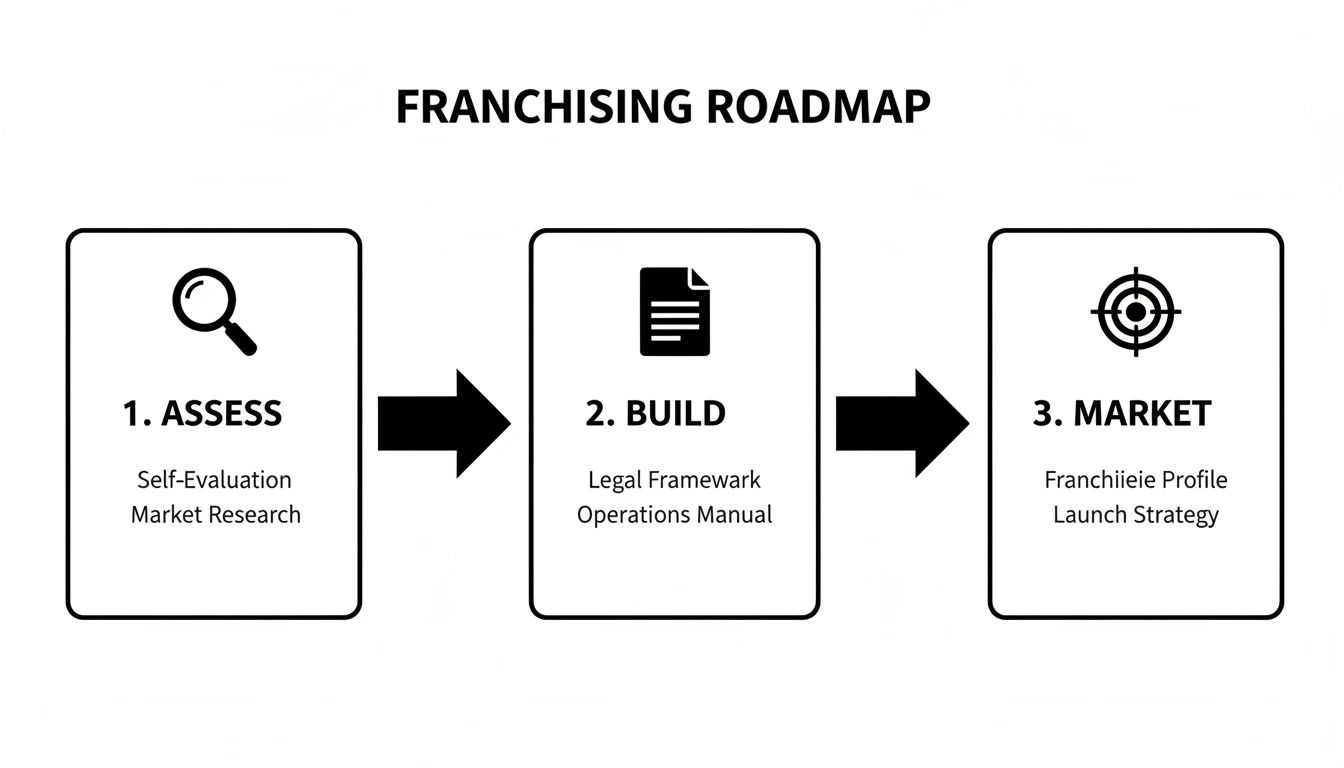
As you can see, success here isn't an accident. It's the result of diligent assessment, foundational work, and a smart go-to-market strategy.
The journey to launching a franchise can seem complex, so it helps to break it down into distinct phases. Each phase has a clear objective and a set of mission-critical deliverables that you need to nail before moving on.
Here's a quick overview of what that looks like in practice.
The Franchisor's Roadmap At a Glance
| Phase | Key Objective | Critical Deliverables | | :--- | :--- | :--- | | Phase 1: Assess | To objectively validate that the business is profitable, replicable, and ready for expansion. | Feasibility study, brand audit, proof of concept financials, competitor analysis. | | Phase 2: Build | To create the legal, operational, and financial framework of the franchise system. | Franchise Disclosure Document (FDD), operations manuals, training programs, territory strategy. | | Phase 3: Market | To attract, qualify, and award franchises to the first group of ideal owner-operators. | Franchise website, marketing funnel, lead qualification process, discovery day plan. |
This table maps out the path from where you are now to welcoming your first franchisee. Mastering each of these stages is what separates the brands that scale successfully from those that stumble.
To really succeed, you'll need to focus on these core pillars:
- Confirming Franchise-Readiness: Is your business really ready? We're talking about proven profitability, a concept that can be easily taught and replicated, and a brand that has some real pull.
- Building the Foundation: This is where you create your bulletproof legal and operational framework. The centerpiece of it all is your Franchise Disclosure Document (FDD).
- Designing an Irresistible Offer: You have to craft a financial and support package that makes high-quality candidates see the value and feel confident investing in your vision.
- Executing Your Go-To-Market Strategy: The final piece is a smart marketing and sales plan that brings qualified franchisee leads directly to your door.
Think of this as your playbook for turning a great local business into a respected national brand. The goal isn't just to grow, but to build something that lasts.
We're going to dive deep into the mechanics of each stage, moving past the theory and into the practical, actionable steps. And for those already thinking ahead, you can explore our detailed guide on franchise growth strategies for sustainable scale in 2026.
By following this blueprint, you're not just preparing for expansion—you're setting the stage for true market leadership.
Is Your Business Actually Ready to Franchise?
So, you've built a successful business and the idea of franchising sounds exciting. It's a powerful way to expand, but the dream of rapid growth can quickly become a nightmare if you jump in too soon. Before you ever talk to a franchise attorney or consultant, you need to take a brutally honest look in the mirror.
The most important question isn't "Is my business profitable?" It's "Is my business replicable?" You have to stop thinking like a passionate founder and start thinking like a skeptical investor. Could a complete stranger, with no background in your industry, follow your playbook and find success? If you hesitate for even a second, you're not ready.
The Hard Math of Franchise Profitability
This all starts with your unit economics—the profitability of a single location. A business that provides a nice living for you as an owner-operator often doesn't have enough meat on the bone to support a franchise model.
Think it through. A franchisee will be paying you an ongoing royalty, typically 4-8% of their gross sales. On top of that, they'll contribute to a national marketing fund, usually another 1-3%. The big question is: after paying you, can they still make a great living and a solid return on their investment?
A potential franchisee isn't buying themselves a job; they're buying a financial return. If your model can't deliver at least a 15-20% cash-on-cash return after all the fees, you'll never attract the sharp, well-capitalized partners you want.
This is the single biggest stumbling block I see. Founders look at their own healthy bottom line and forget that a franchisee will have to carve out a significant chunk of that for royalties. Your flagship location needs to prove it can be wildly profitable even after you account for those future fees.
The Systemization Test: Can It Be Taught?
Profit is only half the battle. The other half is systemization. If your business thrives because of your unique personality, your local reputation, or some kind of "magic touch" that only you have, you can't franchise it. It's a recipe for disaster.
You have to be able to document and teach every single part of the business.
- Customer Acquisition: Do you have a predictable, repeatable marketing system, or do customers just show up because they know you?
- Service Delivery: Are there step-by-step checklists and procedures that ensure every customer gets the same great experience, every time?
- Team Management: How do you hire, train, and manage your staff? Is it documented, or is it just "a feeling you get"?
Imagine handing a binder—your operations manual—to a competent manager, giving them a week of training, and walking away. Could they run the business to 80% of your proficiency just by following the playbook? If the answer is no, you've got more systemization work to do before you can move forward.
Your Brand: Is It Strong and Defensible?
Finally, let's talk about your brand. A powerful brand is more than a cool logo. It's a legally protected asset that commands value in the marketplace. The first step is simple: Have you federally trademarked your name and logo? If not, you're building a house on sand. Another company could pop up with a similar name in another state, creating mass confusion and killing your brand's value.
I once saw a fantastic local taco shop try to franchise. They had lines around the block and tons of local buzz. But they rushed it. Their brand meant nothing one state over, and their success was completely tied to the founding chef's talent. The first franchisees failed miserably, tarnishing the brand and stopping their growth cold.
Contrast that with a "boring" commercial cleaning company I know. They spent a full year documenting every single process, building quality control checklists, and perfecting a lead generation model that worked in any market. Their brand wasn't flashy, but it was professional, protected, and their system delivered predictable results for franchisees from day one. That's the kind of discipline that builds a franchise empire.
Building Your Legal and Operational Foundation
Once you've made the call that your business is ready for the leap, it's time to build the actual framework of your franchise system. This isn't just a paper-pushing exercise. You're creating the infrastructure that will support dozens, or even hundreds, of new locations without buckling. This is where your proven business model gets translated into a legal and operational playbook that a new owner can follow to the letter.
The two most critical pieces you'll develop are your Franchise Disclosure Document (FDD) and your Operations Manual. They serve different functions, but they work hand-in-glove to protect your brand and set your franchisees up for success. Think of the FDD as the legally required disclosure and contract, and the Operations Manual as the user guide for running the business.
Getting the Franchise Disclosure Document Right
The FDD is a hefty legal document, regulated by the Federal Trade Commission (FTC), that you must give to any prospective franchisee. It's broken down into 23 specific sections, called "Items," that cover everything from your company's backstory to the fees, rules, and restrictions they'll be operating under.
Don't let the legal nature of the FDD scare you. In reality, it's your first real chance to establish credibility. A well-prepared FDD is transparent, incredibly detailed, and answers a candidate's biggest questions before they even have to ask.
One of the most scrutinized sections is Item 19: Financial Performance Representations (FPR). While you aren't required to include an FPR, I can tell you from experience that choosing to do so can seriously speed up your sales cycle. This is where you can share historical financial data from your corporate stores. Sophisticated, high-net-worth buyers expect to see this.
A strong Item 19 never makes income guarantees. Instead, it presents clear, factual data on revenue, key costs, and profitability. For instance, you might show the average gross sales and major expense percentages for your locations that have been open for over a year. This gives candidates the real-world data they need to build their own financial projections, which builds immense confidence in your model.
Your goal with the FDD isn't to "sell"—it's to "inform." A transparent, professionally prepared FDD is a clear signal to serious buyers that you are an organized, trustworthy, and buttoned-up franchisor.
Crafting the Operations Manual: Your Ultimate Playbook
If the FDD is the "what," your Operations Manual is the "how." This is your secret sauce, documented in painstaking detail. It's the A-to-Z guide a franchisee will lean on every single day to run their business exactly to your standards. A thin or vague operations manual leads to confused franchisees and creates a massive, unending support burden for your team.
A truly great manual is much more than a list of rules. It should be a living, breathing resource that's easy to search and covers every part of the business.
- Daily Routines: Step-by-step checklists for opening and closing procedures to guarantee consistency.
- Customer Experience: Scripts, talking points, and guidelines for handling every common customer interaction.
- Local Marketing: How to run local marketing campaigns, manage leads, and build a community presence.
- Team Building: Your exact process for finding, hiring, onboarding, and training fantastic employees.
- Financials: Daily accounting practices, inventory management, and how to read and submit reports.
Here's a simple test: if you were to vanish tomorrow, could a new owner run the business perfectly just by using the manual? If the answer is no, it's not detailed enough. This document is the key to brand consistency and the very foundation of your entire franchisee training program.
Assembling Your Legal and Development Team
Learning how to franchise your business the right way is not a solo sport. You have to build the right team, and one of your first calls should be to a franchise attorney. I've seen brands make the costly mistake of using their general business lawyer—don't do it. Franchising is a highly specialized field of law with its own complex web of regulations.
A good franchise attorney does more than just draft your FDD and franchise agreement. They act as a strategic partner, advising you on how to structure fees, map out territories, and stay compliant. They are your first and best line of defense. This initial investment will save you from enormous headaches and potential litigation down the road.
The global franchise market hit $1.8 trillion in 2022, and with high franchisee satisfaction rates, it's a ripe environment for well-prepared brands. To get your piece of the pie, your legal foundation has to be flawless. You can dive deeper into the impressive scale and potential of the franchise industry to understand just how much is at stake.
Designing an Irresistible Franchise Offering
Having a strong brand and your legal documents in order is just the starting point. That's the price of admission. But it doesn't mean you'll automatically attract the top-tier franchise partners you're looking for.
To really win over savvy investors, the franchise offering itself has to be compelling, competitive, and paint a crystal-clear picture of their path to profitability. This is where you package everything a franchisee gets for their investment.

This goes way beyond just selling your product or service. High-caliber buyers aren't just buying a job; they're buying a complete business system, a robust support infrastructure, and a well-defined territory. Your job is to build an offer that makes signing with you feel like the smartest business decision they could possibly make.
Structuring Your Franchise Financials
Getting your fee structure right is a delicate balancing act. You have to cover your costs and turn a profit, of course. But those fees also need to leave plenty of room for your franchisees to earn an attractive return on their own investment. Your financial model will really boil down to three key parts.
-
Initial Franchise Fee: This is the one-time, upfront payment a franchisee makes to join the team. It's what gets them in the door and typically covers the cost of their initial training, launch support, site selection guidance, and the license to use your brand. You'll see initial fees ranging from $30,000 to $60,000, though this can swing wildly depending on the industry.
-
Ongoing Royalty Fee: This is how you'll generate most of your recurring revenue as a franchisor. It's almost always a percentage of the franchisee's gross sales, paid out weekly or monthly. The industry standard hovers somewhere between 4% and 8%.
-
Brand/Advertising Fund Contribution: This fee is also a percentage of gross sales (usually 1-3%) and gets pooled into a central fund. This money finances the big-picture marketing—the national or regional campaigns that build brand awareness on a scale no single owner could afford on their own.
Before you lock in your numbers, do your homework. Dig into what other franchisors in your space are charging. If you decide to set your fees on the higher end, you'd better be prepared to justify that premium with a much stronger brand, superior support, or killer unit economics.
Defining Territories and Support Systems
I've seen it happen time and again: franchisee infighting is a silent killer for emerging franchise systems. And more often than not, a poorly thought-out territory strategy is the root cause. You absolutely must create clear, protected territories that give every owner a fair shot at success without stepping on their neighbors' toes.
A few common ways to slice it up:
- Exclusive Territories: This is the most common. The franchisee gets the sole right to operate and market within a defined geographic area, usually drawn by zip codes, county lines, or a simple radius.
- Population-Based Territories: Here, each territory is defined by a minimum number of people, which helps ensure there's a sufficient customer base to support the business.
- No Protected Territory: This approach often works for service or mobile businesses where a physical storefront isn't the focus. But be warned: you'll need very clear "rules of engagement" for marketing to prevent chaos.
Ultimately, your territory map should be a blueprint for smart, strategic growth, not just a race to plant flags everywhere.
Beyond the map, your support system is what franchisees are really buying. They are investing in your playbook and expertise. High-quality candidates expect world-class training and continuous guidance.
Blueprint for World-Class Franchisee Training
A powerful training program is what gives a new owner the confidence to execute your model flawlessly from day one. I've found that a multi-phase approach works best, taking them from rookie to seasoned operator.
| Training Phase | Objective | Delivery Method | | :--- | :--- | :--- | | Phase 1: Pre-Training | Familiarize the new franchisee with the brand, culture, and foundational business concepts. | Online modules, required reading, initial calls with the support team. | | Phase 2: "Corporate" Training | Deep-dive immersion into all aspects of the operations manual, from marketing to finance. | 1-2 weeks of intensive classroom and hands-on training at your headquarters or a flagship location. | | Phase 3: On-Site Launch | Provide hands-on support during the critical grand opening period to ensure a smooth start. | A corporate trainer spends 3-7 days at the franchisee's new location, helping with final setup and opening day. | | Phase 4: Ongoing Support | Offer continuous coaching, performance reviews, and resources to drive long-term success. | Weekly coaching calls, regional meetings, annual conferences, and a dedicated franchise business consultant. |
This kind of structured support shows you're invested in their success long after the initial check has cleared. When you nail down the details of how to franchise your business, you build an offer that doesn't just attract investors—it attracts the right kind of partners who are ready to grow with you.
Finding Your First High-Caliber Franchisees
With your legal documents and operations manual buttoned up, it's time to tackle the most important part of your growth: finding those first few franchisees. This is a make-or-break moment. The quality of your founding partners sets the trajectory for your entire franchise system.
Frankly, this is where most emerging franchisors go wrong. They pour time and money into crowded franchise portals, only to find themselves buried in leads from "tire kickers" instead of serious investors.

To attract the kind of partners you really want—seasoned executives and successful entrepreneurs with both capital and business savvy—you have to get proactive. The goal isn't to get a flood of leads; it's to start a small handful of high-quality conversations. This demands a targeted, almost surgical approach that cuts through the noise and connects you directly with your ideal candidates.
Think Beyond the Franchise Portals
Franchise portals can feel like a necessary evil, but they're often a fast track to a high volume of unqualified leads and a deeply frustrating sales process. The problem is baked right into the traditional lead generation model. We've seen it time and again, which is why we've written extensively about why franchise lead generation is broken and what to do about it.
A modern playbook for attracting top-tier investors means going where they already are, both online and off. Instead of just waiting for them to stumble across your brand among hundreds of others, you need to be the one to start the conversation.
Here are the high-intent channels we see working right now:
- LinkedIn Sales Navigator: This is your primary weapon. It lets you build hyper-targeted lists of potential candidates based on their industry, job title, seniority, and location. You can pinpoint VPs of Sales, Directors of Operations, or successful local business owners right in your target markets.
- Industry Networking Events: Don't just go to franchise conferences. Go to trade shows in the industries your ideal candidates currently work in. A real conversation with a tech executive looking for their next chapter is infinitely more valuable than a cold, anonymous lead from a portal.
- Wealth Advisor & CPA Partnerships: These professionals are the trusted gatekeepers for high-net-worth individuals. Build genuine relationships with them. When their clients mention wanting to diversify or buy a business, you want your opportunity to be the first one they think of.
This strategy definitely takes more work upfront, but it pays off with a much higher caliber of candidate, saving you countless hours on the back end.
How to Start a Conversation with an Executive
When you reach out to a successful executive on LinkedIn, remember: you are not "selling a franchise." You are presenting a strategic business opportunity. Your message has to be professional, concise, and focused squarely on the investment potential.
For example, skip the generic "Are you interested in a franchise?" message. It gets deleted immediately. Instead, try a tailored approach like this:
Example Outreach Script
"Hi [Candidate Name], I came across your profile and was impressed by your background in [Their Industry/Field]. We are expanding our [Your Brand Type] concept into the [Their City] area and are selectively connecting with a few experienced leaders who may be interested in a strategic opportunity to build a significant business asset in the market. Would you be open to a brief, introductory call to see if this aligns with your long-term goals?"
This script works because it shows you've done your homework, it frames the opportunity as exclusive, and it centers on their goals, not just your need to sell a unit. The only goal of this first touchpoint is to secure a 15-minute exploratory call. That's it.
A Multi-Step Qualification Funnel That Actually Works
Once you get a candidate on the phone, your job is to qualify, not sell. A smart qualification process vets people on multiple levels before they ever see a full presentation. This fiercely protects your time and ensures you're only spending it with people who are a real fit.
A solid process moves through a few key stages:
- The Intro Call (15-20 Minutes): This is all about finding a mutual fit. Give a quick overview of the concept, then immediately turn the focus to them. Ask about their background, financial goals, and timeline. Key questions are: What's prompting you to explore business ownership now? What's your target investment range? What are you really looking for in a business model?
- The Financial Pre-Qualification: Before you go any further, you have to talk about money. This isn't rude; it's respectful of everyone's time. A simple, professional way to phrase it is: "Our typical all-in investment is around $XXX,XXX. Does that fall within the range you're comfortable with?" Any hesitation here is a major red flag.
- The Program Review & FDD: If they pass those initial screens, now you can schedule a longer call. This is where you walk them through the business model, your support systems, and the Item 19. After that call, you send the Franchise Disclosure Document (FDD) for their review.
This disciplined process ensures that by the time you're investing serious time with a candidate, they've already been vetted for financial capacity, operational aptitude, and cultural fit. It's a world away from the traditional portal approach, where you might not discover a deal-killing issue until weeks into the process.
Lead Source Comparison: Traditional vs. High-Intent Pipeline
The difference in outcomes between these two approaches is stark. While traditional methods seem cheaper on the surface, the hidden costs in wasted time and effort are enormous.
| Metric | Traditional Franchise Portals | High-Intent Pipeline | | :--- | :--- | :--- | | Lead Quality | Low; often "window shoppers" | High; financially qualified and experienced | | Time to Qualify | High; weeks of follow-up | Low; qualification happens upfront | | Lead-to-Close Rate | Very low (1-2%) | Significantly higher | | Cost Per Acquisition | Appears low, but high when factoring in wasted time | Higher initial effort, but lower true cost |
Ultimately, building a high-intent pipeline transforms your franchise development from a reactive, frustrating numbers game into a proactive, strategic search for the right partners. This is fundamental to franchising your business for long-term, sustainable success.
Common Questions About Franchising Your Business
Even the most prepared founders have questions when they decide to franchise. That's completely normal. You're stepping into a new world of legal documents, operational scaling, and brand expansion.
Let's cut through the noise and tackle some of the most common questions I hear from entrepreneurs just like you.
How Much Does It Cost to Franchise a Business?
You should budget anywhere from $50,000 to over $200,000 to properly set up your franchise system. The final number really depends on how complex your business is. This isn't one single check you write, but a series of crucial investments to build your foundation.
Here's a rough breakdown of where that money goes:
- Legal & FDD Preparation: This is a big one. A good franchise attorney will draft your Franchise Disclosure Document and Franchise Agreement. Don't skimp here.
- Operations Manual Development: You're essentially creating the bible for your business. This means documenting every process in a way that someone new can easily follow.
- Initial Marketing Materials: This covers your franchise sales website, brochures, and the budget for your first lead generation campaigns to find those initial buyers.
- Consulting Fees: Working with an experienced franchise consultant can help you sidestep common pitfalls and nail your strategy from day one.
You have to see this as a capital investment in a new growth channel, not just an expense. This isn't a cost center; it's the launchpad for your national brand.
How Long Does the Franchising Process Take?
From the day you commit to franchising to the day you're legally ready to sign your first franchisee, you're looking at about 6 to 9 months.
I can't stress this enough: rushing this process is one of the most expensive mistakes you can make. This time is filled with essential work—finalizing your readiness checks, drafting legal docs with your attorney, meticulously building out your operations manuals, and creating your entire franchisee marketing and sales plan. Trying to cram that into a few months always leads to a weak foundation that cracks under pressure.
Do I Really Need a Franchise Consultant?
Legally? No. Strategically? Absolutely. While you aren't required to hire one, a seasoned franchise consultant is your guide through an unfamiliar and often tricky landscape. They've made this journey dozens of times and know where the landmines are.
A great consultant offers an objective, outside perspective on everything from structuring a competitive franchise fee to building systems that can actually support a growing network. Their real value is in helping you avoid the rookie mistakes that sink so many emerging brands. They help you get your first few high-quality franchisees signed, which sets the tone for the future of your entire system.
What Is a "Franchise Tax"?
This one causes a lot of confusion. The name is misleading. A franchise tax, like the one used in Texas, is simply a state-level tax for the "privilege" of doing business in that state.
It applies to most business entities (like LLCs and corporations), not just franchises. It has absolutely nothing to do with the franchise royalties or fees you'll be collecting from your franchisees. For more details on specific state-by-state rules, we often post in-depth articles on our blog.
Ready to stop wasting time on unqualified leads and start talking to serious investors? At Franchise Fast Track, we deliver appointments with verified high-income buyers directly to your calendar. Learn how our system can build a predictable pipeline for your brand at franchisefasttrack.io.
Ready to see results like these for your franchise?
Stop wasting money on leads that never close. Start getting hundreds of replies from high-income professionals daily.
Apply For Exclusive Access